
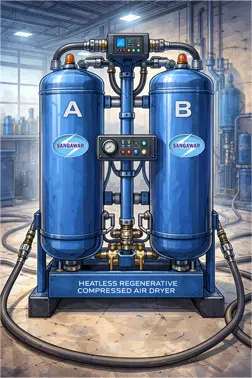
Engineered for Reliability. Designed for –40°C Precision.
In industrial environments, moisture is more than an inconvenience—it’s a silent threat to productivity, equipment life, and product quality. At Sangawar Pneumatics, we design Heatless Regenerative Compressed Air Dryers for operations that cannot afford compromise.
Our systems consistently deliver ultra-dry compressed air at a –40°C Pressure Dew Point (PDP), ensuring reliable performance even in demanding and low-temperature conditions.
Whether you’re running precision instrumentation, chemical processing lines, or critical automation systems, Sangawar Pneumatics ensures your compressed air stays clean, dry, and dependable—around the clock.
Why Heatless Regenerative Dryers Are the Industry Standard for Ultra-Dry Air
Conventional refrigerated air dryers are typically limited to a pressure dew point of around +3°C. While sufficient for basic applications, this level of dryness is not suitable for industries where moisture can cause corrosion, freezing, or product contamination.
Heatless regenerative desiccant dryers, powered by Pressure Swing Adsorption (PSA) technology, remove water vapor to extremely low levels—making them essential for:
Built for Continuous Industrial Operation
Every Sangawar Pneumatics heatless dryer is engineered for 24/7 duty, combining rugged construction with intelligent control.
Key Performance Highlights
Technical Comparison at a Glance
| Feature | Typical Industry Range | Sangawar Advantage |
|---|---|---|
| Pressure Dew Point | –20°C to –40°C | Consistent –40°C for ultra-dry applications |
| Operating Pressure | 5–10 kg/cm² | Up to 12.5 kg/cm² (custom high-pressure options available) |
| Desiccant Material | Silica Gel / Mixed Alumina | Premium Activated Alumina |
| Cycle Timing | Fixed cycles | Optimized 4–10 minute cycles |
| Inlet Temperature | Up to 40°C | Compatible with aftercoolers Colors |
How the Heatless Drying Process Works
1.Adsorption PhaseMoist compressed air enters the active tower under pressure. The desiccant bed adsorbs water vapor, allowing only ultra-dry air to pass through.
2.Regeneration Phase
A small portion of the dried air is expanded to atmospheric pressure and directed through the second tower. This purge air removes the accumulated moisture from the desiccant.
3.Automatic Tower Switching
After a preset interval, the roles of the towers reverse—ensuring continuous delivery of dry air without interruption.
Industries That Trust Sangawar Pneumatics
Our heatless air dryers are widely used across industries where air quality directly affects performance and safety:
Pharmaceutical Manufacturing – Dry, contamination-free air for coating, packaging, and cleanroom processes
Automotive & Paint Shops – Moisture-free air for flawless paint finishes
CNC & Precision Machining – Protects spindles, tools, and pneumatic systems
Electronics & Semiconductor Assembly – Zero humidity to prevent defects and static damage
More Than Equipment — Complete Air Quality Assurance
At Sangawar Pneumatics, we go beyond supplying dryers. We engineer customized air treatment solutions based on your flow rate, pressure, and dew point requirements. Every system is thoroughly tested to ensure long-term reliability and compliance with industrial standards.
Protect your equipment. Improve efficiency. Eliminate moisture-related downtime.
Frequently Asked Questions
It is a twin-tower desiccant dryer that uses Pressure Swing Adsorption. One tower dries the compressed air while the activated alumina in the second tower is regenerated at atmospheric pressure. The towers switch automatically, so you get an uninterrupted supply of ultra-dry air.
A stable –40°C pressure dew point as standard, with an optional –70°C configuration for extreme applications. This keeps the air dry even when ambient temperatures fall well below freezing.
Refrigerated dryers are limited to around +3°C, which cannot prevent condensation, freezing or corrosion in cold, outdoor or precision applications. A –40°C heatless dryer removes water vapour to ultra-low levels for instrument air, chemical processing and critical automation.
Roughly 15% of the dryer's rated airflow is used to regenerate the desiccant. Calibrated orifice plates keep this purge loss to a minimum while holding the dew point steady.
Heat Reactivated Dryers use external heaters to regenerate desiccant, reducing purge air but increasing system complexity and capital cost.
With good upstream filtration, activated alumina typically lasts 2 to 3 years. Oil contamination shortens its life, which is why a high-efficiency oil-removal pre-filter is strongly recommended.
Yes. A pre-filter upstream removes oil and moisture aerosols that would damage the desiccant, and an after-filter downstream captures desiccant dust. Both protect the dryer and your downstream equipment.
It performs best with an inlet temperature of 35°C to 45°C. For hotter discharge air, an after-cooler or pre-cooler protects desiccant efficiency and extends service life.
The dryer is sized to your actual air flow, working pressure and required dew point. Share your compressor's free air delivery, line pressure and target dew point and we will recommend the correct model.